Tag: creativity

  • An Upgrade is Available for Your God(s)

    An Upgrade is Available for Your God(s)

    The more I write about tech, artificial intelligence, and algorithms, the more I sound like I’m talking about religion.

    Estimated reading time: 5 minutes

    Humans Need to Know Why

    Like many folks in this era of podcasts, I have listened to far too many true crime stories to be healthy. 

    There is one thing I find extremely fascinating about the families of the victims. They’ve expressed a common feeling that’s surprising, when the full fate of their loved-one isn’t fully known. Say a person has gone missing, evidence indicates they were likely murdered, but their body is never found, and the details are murky, the suspect isn’t talking, etc. 

    These poor folks will often say something like this, “Not knowing is the most difficult part. I would rather know that he’s dead than just not know anything.”

    To me, that is an amazing statement. 

    These people, suffering at an intensity most of us will fortunately never know, say they would rather have confirmation that their loved one is deceased – rather than simply not know the horrible details of what befell them.

    I’ve heard it over and over from the victim’s surviving families. Suffering a list of horrible emotions, they all say not knowing is the worst of all. 

    It’s common to us all. We humans hate not knowing. We are curious and we need to know why. It’s hard to reduce the evolution and success of our species to a more compact phrase. 

    Gods and Tech Upgrading in Sync 

    Our need to explain why things happen is so powerful that to relieve the agony, we’ll make up stories to explain it. Yes, I’m talking about religion right now, but the need to have a clear why applies in many other areas. It explains the popularity of fact-free conspiracy theories, and much more.   

    Of course, what feeds our explanations (fact-based or not) of why things happen are the ideas around us, is the current technology. As technology upgrades, speculations of “Why?” changes in parallel.

    Early explanations of the unknown didn’t involve much tech. Everything simply had a spirit that animated it.  

    Then came Gods – the “alphas” of a tribe. They mirrored the ruling caste of growing bands of humans. Then God became a singular king-like being who ruled over mortals, since kings were the most powerful earth-based beings.

    Now, in this computer age, we are seeing the emergence of upgraded “god theories” that match the currently most advanced technologies. God is an artificial intelligence, a computer, life itself is a simulation, etc.

    As technology becomes a bigger part of people’s lives, I hear the same language in the explanations of how the mysterious algorithm works, as are usually used to describe the mysterious will of God.  

    The Mysteries of The Algorithm

    While discussing the whys of algorithms, you’ll notice the same ideas and events that occur when people turn to religious thought. Where there is the unknown, there will be a rise of prophets who claim to have the answers, claim to have the ability to influence the algorithm (or God) and they will gladly share their knowledge — for a price.

    On a writing forum recently, a person complained they were posting plenty of content on a social media platform but not gaining many followers. It’s well-known now that social site algorithms respond to “engagement.” Just posting isn’t enough. To get approval from the algorithm, you need to reply, like, and share others’ posts as well. Here was my suggestion to the would-be influencer: 

    The Mighty Algorithm rules all. You are not sacrificing enough of your time for it to consider returning your gift. You must interact with others and increase your holy engagement. Only then shall ye be rewarded. 

    I wrote it that way because it seemed the same solution offered in ancient times to influence the gods: make a decent enough sacrifice to increase the odds of them heeding your prayers.  

    I’ve joined in this new angle on the same old religion with phrases such as –

    • Praise the mighty algorithm – may it bless my content.
    • O, holy algorithm, I pray you use your mysterious powers to guide this post to many likes. 
    • Glorious algorithm, I have spent this last hour on your platform as sacrifice. Please now promote my influence.

    I’m not freshly converted, I just figure if we’re going to use religious-like talk about the algorithm, we may as well make it sound more official.

    And while I sound here like my tone is above it all, or sarcastically playing the newly converted, let me clarify. For I do know the true way to manipulate the gods old and new. I do indeed know the spell, the incantation.

    There is one certain way to earn the favor gods digital and human… pay cash. 

    The One True God 

    Yes. That is my secret to manipulate the mysterious algorithm. I pay as little as possible for the cheapest ads I can afford — that will drive visitors to my books on Amazon.

    A tribute to the real god behind all gods always works and always has worked. Because if there is one true god across all facets of humanity, it’s money. (For my fellow 80s kids, yes, the film They Live got it right.) 

    That type of tribute, that sacrifice, has reliably worked miracles for as long as there have been humans to wonder how to manipulate other humans.

    I think the parallels between mysterious algorithms and religion tie up neatly in this final revelation. What we often call the unknown mysteries, or the motivations of a divine being are often just other mortals, hiding their knowledge, pulling hidden levers, and presenting a show. All to control a man-made system but make it appear divine.

    As ever, what appears the presence of a mystical force is just someone putting their finger on the scale. They are easily and reliably moved with a tithe.  

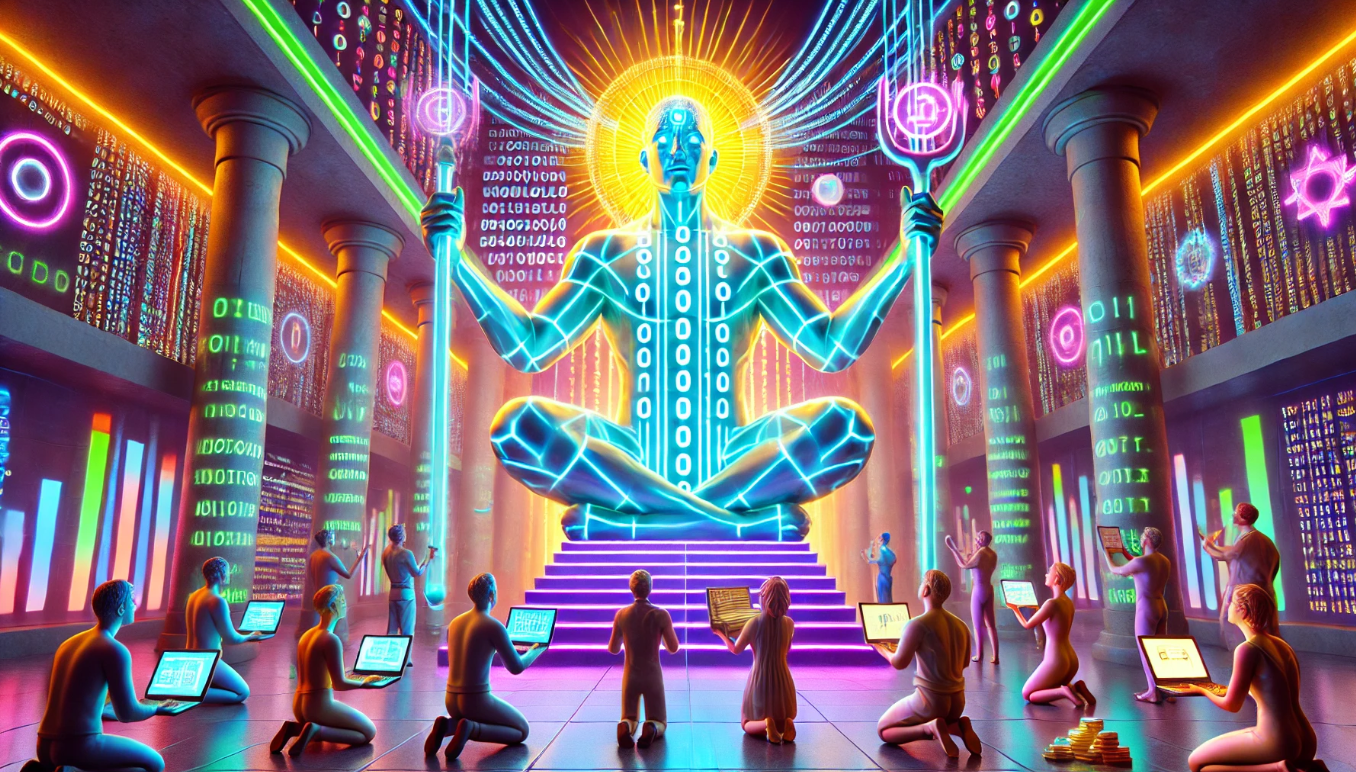
    Image generated by Chat GPT A.I., prompted by the text of this essay.
  • Am I a Fool for Loving Generative A.I.?

    Am I a Fool for Loving Generative A.I.?

    If Generative A.I. Is Wrong, I Don’t Want to be Right

    Estimated reading time: 6 minutes

    I don’t remember much about grade school, but I clearly recall a classmate’s kindness. In art class, this one kid made drawings that were always fantastic. Mine were always less than. Far less than. I asked him his secret, expecting him to keep such valuable knowledge to himself. 

    He shared generously and without hesitation. “When you fill in a shape, make sure you color in the same direction.” 

    During our next art class, I tried it. The result? My drawing still looked terrible and his still looked amazing.

    That was my first lesson in talent. He was skilled at something, and I wasn’t. I could work for it, but it seemed far too much work.

    I would spend my years envying visual artists of all kinds and their ability to create astounding imagery.

    Sufficiently Advanced Tech 

    Fast forward to today. Along comes generative A.I. DALL-E, Adobe Firefly, Bing Copilot, and so many others, and it feels like a miracle. Because with those tools, so simple, so powerful, so fast, I can draw! I CAN DRAW!!!!

    Correction. I still can’t draw, but I can generate visuals that without that software, I wouldn’t be able to create in a thousand years. That frustrated kid from grade school, who couldn’t draw as well as his classmate even as his mate helped him, has waited for decades and now, finally, finally, finally, I can create art!

    Like Arthur C. Clarke’s brilliant observation: any sufficiently advanced technology will feel like magic. To me, generative A.I.’s image-making abilities feels like something mystical.

    The A.I. Mindset 

    I’m sharing my very positive experience with generative A.I. because I feel compelled to stick up for my friend. A.I. isn’t all bad. Not by a longshot. It could just be my filter bubble, my self-trained algorithm, but it seems like the negative aspects of A.I. get most of the hype. 

    Even when A.I. existed only in our imaginations, there were warnings about it. Science Fiction authors alerted us to the dangers long ago.

    Maybe you’re one of these A.I. haters, annoyed that I like A.I. for what it can do for me. 

    “You could have developed your drawing skill,” some might say. “You could have practiced hard and worked at it.”

    Yes, I know. Instead of saying “I can’t draw,” I’m supposed to say, “I can’t draw… yet.” I know, I know. I too read Carol Dweck’s superb book Growth Mindset (affiliate link) that explains that thinking in depth. Yes, that’s the right attitude.

    If I work at it, I could be a visual artist without A.I. Had I worked at it, I would be one already. Maybe. But it would have taken years upon years upon years of training and practice, years I don’t have and years I don’t want to have. I dedicated those years to writing, and I want to dedicate the years in the future to writing. 

    Now I have a tool that can take a visual idea and make it happen. That is incredible! I love it! 

    A Dangerous Optimism

    “Well sure,” our imaginary hater might say, persisting in this argument, “It’s not your trade that’s being overrun by A.I. That’s why you like it.” 

    Um, actually! My trade (writing) is in just as much danger, if not more. A.I. can write, too. I’m not afraid of it though. What I’ve seen is rather lifeless. 

    Also, lifeless writing created by humans gets published all the time. Further, I see it A.I. as a challenge – it will push me to be even more creative, to achieve, as I’ve said before — something so real it can’t possibly be created by A.I. I’m already competing with millions of faceless writers online, what’s a few million more?  

    Besides, what if my artist pal from grade school had the reverse problem? He can draw, but what if he had (and still has) trouble assembling words? He may be just as thrilled about generative A.I. as I am, wherever he may be. 

    So just because it doesn’t affect me doesn’t mean it’s okay, which is the tentative guilt I feel at loving A.I.

    Forbidden Love

    I am torn when I express my love for Generative A.I. On the one hand there are people I trust saying it’s dangerous. 

    On the other hand, there are people I don’t trust (the techbro douche-o-sphere) hyping every tech advance with religious fervor and causing mayhem. Lately they’ve been rebranding everything as A.I.-powered to keep that investment cash rollin’ in, even if it’s as “A.I-Powered” as a standard phone voice tree. 

    And so, going against people I trust, I wonder, am I allowed to think that A.I. is cool? Amazing? Am I allowed to love it? Or am I embracing our doom? Am I being naive? Is my dangerous optimism leading me wrong again? 

    Yes, I understand that A.I. can be a danger to creativity, it can be a danger to those who make their living creating astounding imagery all on their own. No, I don’t know where A.I. will take us as a society, as a species. Probably the usual mix: more horrors, more wonders. 

    If I could bring it back down to my tiny world, I’m just glad it awakened that kid in me who wanted to draw, forgot he even cared about it for decades and now suddenly, he can. 

    Imagination at Play

    A.I. is a tech marvel. There are complex issues that affect people’s lives, our civilization, our whole species. 

    That’s all true, but just for a moment, can I simplify? Can I say I love generative A.I.? Can I admit I recognize the dangers to people’s employment, and all that but I love it all the same. Just to play. When was the last time tech – or anything – came along and you played with it? Or marveled at its abilities as it filled you with ideas? 

    I’m still a kid in grade school with bricks for hands but still loving the feel of those chunky crayons. I feel like a kid on a slide for the first time, screaming “Wheeeeee!”  

    That’s how I feel playing with generative A.I. and making pictures. like every aspect of all our impressive gadgets, there’s some good things, some bad. 

    For now, I want to ignore the bad because the good isn’t just good. It’s magical. I just want to play.

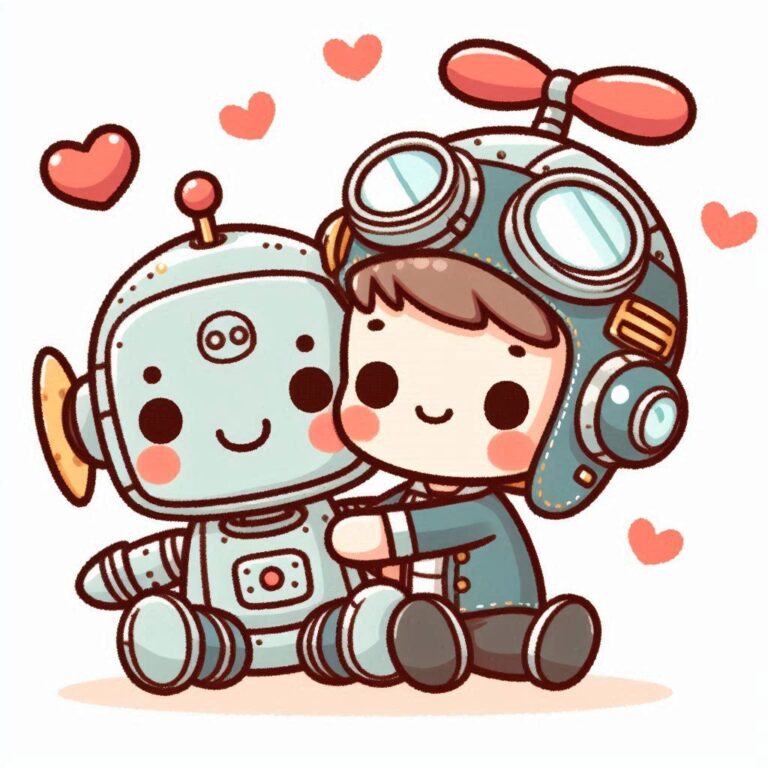
    Image created by Bing Co-Pilot A.I. Prompt: a cute illustration of a boy wearing a propeller hat hugging a robot with hearts around their heads.

  • How to Use Words with Maximum Impact

    How to Use Words with Maximum Impact

    Estimated reading time: 4 minutes

    Word Police on Patrol

    There’s this interesting video where a girl asks why we call something “man-made” (here) when women were also a part of its construction.

    Many explode with rage over the suggestion that we alter or update our language. I’m not one of them. People who rage at the idea that we use a new word are annoying.

    Equally irritating are those who attack anyone who fails to use the most modern terms. The rules of vocabulary are ever-shifting and agreed-upon by unofficial consensus of … who knows?

    I don’t agree with either extreme. Language is an art and is always inexact. It’s clumsy and messy. Rarely does someone use it with laser-like precision. Rarer still, does someone use with adherence to the human rights and history, etc. One could argue that any popular language is by default the tongue of a conqueror.

    Then there’s context. Context is king. Who is speaking? To whom? Where? What’s the goal? Speed? Accuracy? The environment? Formal? Casual? So many variables come into play.

    Context is the Forest, Words are the Trees

    I experienced the power of context during a recent trip to Mexico, where I attempted to speak Spanish. I use an app to practice. It’s challenging and fun, but a little impractical. I like to joke that if I’m ever in Mexico and someone asks me ‘Is the cat sitting on the table?’ I’m all set.

    Haha, right? But when I was in Mexico, my abilities were far better than I expected. I think I owe that sudden boost to context. When you’re in a hallway and you must step around someone, you need a simple phrase. Even if you botch it, they know you mean, “excuse me.” If you’re in an airport or a hotel or a restaurant and you approach a clerk, chances are you’re asking how to find the toilet.

    Yes, I’m a wordsmith (sounds cooler than ‘writer.’) But I don’t agree that words should be policed with the zealotry they often are. Communication is sloppy and imperfect. That’s also part of the fun. That looseness allows for creativity. Verbal jazz, baby. Word artistry, dig?

    The Mysterious Case of the Appreciated Films

    Back to the girl who complained about the term “man-made.” I agree with her. It’s a lousy term. Not a crime, but not great. Some roll their eyes at word-changing suggestions. I don’t. It’s better to consider the argument. So please, travel with me along my thought-path as we assess our friend’s suggestion that we ditch “man-made.”

    As a man, it’s easy for me to retort, “In that context, when we say ‘man-made’ we mean human-made.” I could stop there, but let’s fire up some empathy. Such an open-n-shut judgment is easy for me to say — since I happen to fall into the group. But it seems to have irked the girl — and I know it irks women of all ages.

    It reminds me of when the original Black Panther and Wonder Woman films came out. The first ones were above-average flicks. But people were reacting positively to them far and above enjoying a great movie. They were ecstatic. Many explained how wonderful it was to finally see someone who looked like them as the hero.

    I’m ashamed to admit I was a little confused by that. I thought, what’s the big deal? Superheroes embrace universal values. Then again, for a long time, most comic book and movie heroes appear as males of European ancestry like me. I never thought of it until I saw others’ reactions.

    Taking Representation for Granted

    I had been taking my representation for granted. I never knew it was something one could desire because I never felt its absence. Well, I know now. Representation matters — and if it matters to you, it matters to me.

    Some efforts to change language seem lazy, an attack on the easy part of a genuine problem. But sometimes it’s as simple as an inconsequential switch with a big payoff. I’m not going to fight to the death to use the term “man-made.” “Artificial” works as well and doesn’t alienate half of our species.

    But then, I won’t hate someone if they use an antiquated word. Words don’t matter as much as intent. Clinging to an inexact word is not something I care to do, but being able to express an idea with maximum force?

    Now, that is what I’m passionate about.

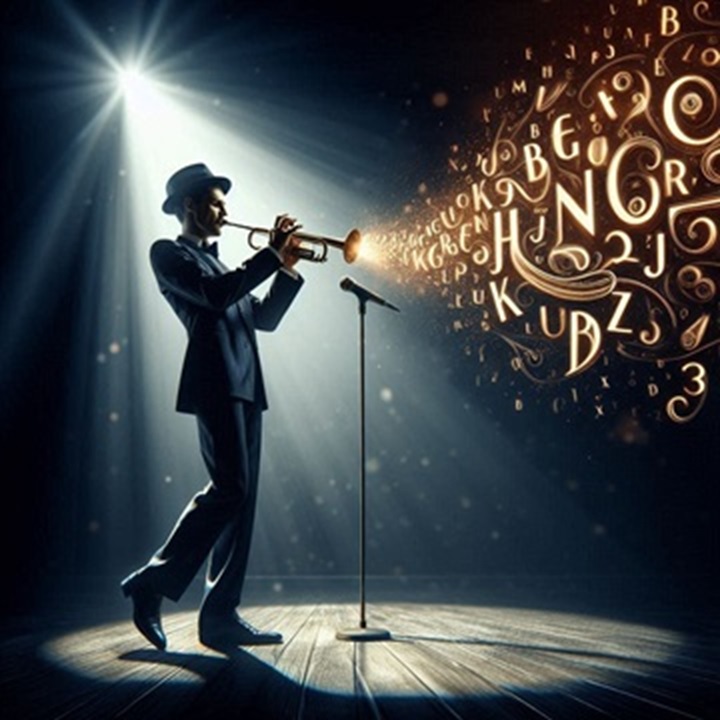
    Image by Bing Copilot AI. Prompt: create an image of a smooth cool jazz trumpet player along on a stage in a spotlight in a dark nightclub. There is a stream of letters coming out of his trumpet