It’s a popular riddle: If a tree falls in the forest and no one is there to hear it, does it still make a sound?
The answer is obvious! The answer is No. The tree crashes to the ground completely silent. If you are not personally there to witness an event, obviously — quite obviously — it doesn’t happen.
This is why when you meet a young child, they will be the same age, even if you meet them years later. That four-year-old distant relative who wants to be a fireman? When you see him again ten years later, take notice that he’s still four. He only ages in your presence.
Haven’t you ever wondered why all trees outside of your perception stay the same height and size?
If you travel to a nation you have never been to before, take notice how they are still using stone age tech. Once you are present to witness them, they will breathe a sigh of relief, mobbing you like a messiah. I bet you always wondered why they begged you to stay. “We want to progress beyond smoke signals now and use cellphones. Finally! Stay! Oh, please stay.”
Further, did you know that if you simply close your eyes, everyone stops moving? They start again only when you open your eyes. This is also a good way to silence people you don’t want to hear from. Our world is amazing.
If you’re not there with your high-vis vest, hard hat and checklist, then nothing is going to happen. When you sleep, absolutely nothing happens. The universe is like a lazy worker. It doesn’t do anything unless the boss is present. Otherwise, it’s frozen still.
If a tree falls in the forest and no one is there to hear it, does it still make a sound? Why is this even a question? Of course it doesn’t make a sound. You are the center of the universe and nothing happens without you. Riddle solved.
Now go take a selfie.
Image generated by Google Gemini AI and tweaked with some photo editing fun.
If you liked this clever smart-assery and simply must have more fun like it, then get your sexy self over to LarryNocella.com or better yet, try out the latest book: One Odd Cat, available on Amazon (affiliate link.)
The more I write about tech, artificial intelligence, and algorithms, the more I sound like I’m talking about religion.
Estimated reading time: 5 minutes
Humans Need to Know Why
Like many folks in this era of podcasts, I have listened to far too many true crime stories to be healthy.
There is one thing I find extremely fascinating about the families of the victims. They’ve expressed a common feeling that’s surprising, when the full fate of their loved-one isn’t fully known. Say a person has gone missing, evidence indicates they were likely murdered, but their body is never found, and the details are murky, the suspect isn’t talking, etc.
These poor folks will often say something like this, “Not knowing is the most difficult part. I would rather know that he’s dead than just not know anything.”
To me, that is an amazing statement.
These people, suffering at an intensity most of us will fortunately never know, say they would rather have confirmation that their loved one is deceased – rather than simply not know the horrible details of what befell them.
I’ve heard it over and over from the victim’s surviving families. Suffering a list of horrible emotions, they all say not knowing is the worst of all.
It’s common to us all. We humans hate not knowing. We are curious and we need to know why. It’s hard to reduce the evolution and success of our species to a more compact phrase.
Gods and Tech Upgrading in Sync
Our need to explain why things happen is so powerful that to relieve the agony, we’ll make up stories to explain it. Yes, I’m talking about religion right now, but the need to have a clear why applies in many other areas. It explains the popularity of fact-free conspiracy theories, and much more.
Of course, what feeds our explanations (fact-based or not) of why things happen are the ideas around us, is the current technology. As technology upgrades, speculations of “Why?” changes in parallel.
Early explanations of the unknown didn’t involve much tech. Everything simply had a spirit that animated it.
Then came Gods – the “alphas” of a tribe. They mirrored the ruling caste of growing bands of humans. Then God became a singular king-like being who ruled over mortals, since kings were the most powerful earth-based beings.
Now, in this computer age, we are seeing the emergence of upgraded “god theories” that match the currently most advanced technologies. God is an artificial intelligence, a computer, life itself is a simulation, etc.
As technology becomes a bigger part of people’s lives, I hear the same language in the explanations of how the mysterious algorithm works, as are usually used to describe the mysterious will of God.
The Mysteries of The Algorithm
While discussing the whys of algorithms, you’ll notice the same ideas and events that occur when people turn to religious thought. Where there is the unknown, there will be a rise of prophets who claim to have the answers, claim to have the ability to influence the algorithm (or God) and they will gladly share their knowledge — for a price.
On a writing forum recently, a person complained they were posting plenty of content on a social media platform but not gaining many followers. It’s well-known now that social site algorithms respond to “engagement.” Just posting isn’t enough. To get approval from the algorithm, you need to reply, like, and share others’ posts as well. Here was my suggestion to the would-be influencer:
The Mighty Algorithm rules all. You are not sacrificing enough of your time for it to consider returning your gift. You must interact with others and increase your holy engagement. Only then shall ye be rewarded.
I wrote it that way because it seemed the same solution offered in ancient times to influence the gods: make a decent enough sacrifice to increase the odds of them heeding your prayers.
I’ve joined in this new angle on the same old religion with phrases such as –
Praise the mighty algorithm – may it bless my content.
O, holy algorithm, I pray you use your mysterious powers to guide this post to many likes.
Glorious algorithm, I have spent this last hour on your platform as sacrifice. Please now promote my influence.
I’m not freshly converted, I just figure if we’re going to use religious-like talk about the algorithm, we may as well make it sound more official.
And while I sound here like my tone is above it all, or sarcastically playing the newly converted, let me clarify. For I do know the true way to manipulate the gods old and new. I do indeed know the spell, the incantation.
There is one certain way to earn the favor gods digital and human… pay cash.
The One True God
Yes. That is my secret to manipulate the mysterious algorithm. I pay as little as possible for the cheapest ads I can afford — that will drive visitors to my books on Amazon.
A tribute to the real god behind all gods always works and always has worked. Because if there is one true god across all facets of humanity, it’s money. (For my fellow 80s kids, yes, the film They Live got it right.)
That type of tribute, that sacrifice, has reliably worked miracles for as long as there have been humans to wonder how to manipulate other humans.
I think the parallels between mysterious algorithms and religion tie up neatly in this final revelation. What we often call the unknown mysteries, or the motivations of a divine being are often just other mortals, hiding their knowledge, pulling hidden levers, and presenting a show. All to control a man-made system but make it appear divine.
As ever, what appears the presence of a mystical force is just someone putting their finger on the scale. They are easily and reliably moved with a tithe.
Image generated by Chat GPT A.I., prompted by the text of this essay.
Today in the mental model repair shop, we’re going to discuss how we assess hypocrisy. We’ll start with a specific anecdote and expand the lessons learned for many situations.
Hating Dissent in the Land of the Free
Long ago, my primary cause was animal rights. I read all the books, visited vegan restaurants, and attended protests against animal cruelty. Regarding those rallies, I was shocked at the scorn we received. Not because people disagreed with us, but because they seemed to dislike protest as an idea—without even knowing our cause. Maybe it was paranoia, but I often felt an ambient hostility from those passing by before they could see our signs or talk to us.
I gradually realized that people love to complain, but they hate hearing others do it. This attitude permeates American life. “America! Love it or leave it!” Wait, can’t I stay and voice a concern?
It still shocks me that most Americans have never used their First Amendment right to stand somewhere with a sign and protest anything. Do they really find everything perfect exactly how it currently is? Protesting is 100% legal. Why not do it? Because nobody wants to hear complaints, and people instinctively know if they complain, they’re in for some disdain.
The Classic “Sticker Defense”
Those driving by would often yell something, but it was impossible to understand them. Here’s a tip for drive-by commenters: hand gestures (thumbs up or middle fingers) are more effective. Funny thing is, from a distance, and at high speeds, they look the same.
For those walking by, there was a different tradition. Haters would point at our shoes and laugh. “You hypocrite! You care about harming animals for fur, but you’re wearing leather shoes!” Like too many wannabe-wits, these folks always considered this oft-repeated criticism wildly original, totally hilarious, and a complete invalidation of the suggestion that we shouldn’t be cruel to animals.
I had the solution. I printed labels with big block letters that read, “NOT LEATHER.” Each protester stuck them to the top of our shoes. Most of us wore niche brand vegan footwear—rubber, canvas, etc.—so this was mostly true.
When one of these aspiring contrarians strolled by and attempted to demonstrate their unique humor with a comment we had heard a thousand times, they would look down, point, and BAM! Thwarted!
A Busted Mental Model
Despite that, I took to heart the criticisms of hypocrisy. There was a grain of truth in them. In the years since, I’ve noticed that it’s a standard line of attack against anyone who proposes an idea for positive change.
Instead of assessing an idea, mediocre minds immediately size up the messenger, searching for any failing. No matter how microscopic, one is inevitably found, and the lazy thinker gladly returns to their unchanged mind, confident that the one speck of inconsistency holds back an avalanche of support.
I wanted to ask these folks. “Do you really think a vegan, sincere about their beliefs, trying with all their might to avoid animal cruelty, would buy leather shoes on purpose?” The answer is, “Of course not.”
Dear reader, have you ever tried to buy footwear that isn’t leather? Back then (20+ years ago) it was nearly impossible. It’s better now, but still not easy. There are many things labeled cruelty-free that sure feel like they aren’t. Have the materials changed? Or just the labeling?
It’s not necessarily the vegan who is hypocritical. The systems we live in don’t allow for many choices that are kind to our fellow animals.
A Lack of Options
That is the core of today’s discussion: whether by natural law or by human design, our choices are often so limited that we seem to be hypocrites no matter what we attempt. Our ability to impact the world as we desire is often impossible due to a restricted field of options, not our failures.
Suppose you want to resist the ongoing atrocities of the oil and gas industries (endless wars, climate change, worker exploitation, etc.) You buy an electric car. Then you learn that building them is also damaging to the environment. So you buy a bicycle. But there are no bike paths. Bicycling on roads with cars isn’t safe and is often illegal. You try and try, but your choices are limited, and/or your life is made more difficult. But if you finally get there, someone will point out the tires on your bike and the paved roads are also petrol products. Oh well.
This isn’t to whine that creating change is difficult—it always will be. My point is that we live in several severely controlled and artificial environments that have made 100% purity in our drive for positive change with personal choices nearly impossible.
Let’s try buying clothes. Many manufacturers have horrible labor practices in countries with no worker protections. You could make your own. But few have the skill to do that. Just because someone says, “I’m anti-child labor,” yet they wear shoes made in a factory that supports child labor – doesn’t mean they are wrong. It could mean they’re lazy and want the appearance of caring. It could also mean that buying new clothes that don’t exploit labor is nearly impossible.
I’ve seen this before. Someone says, “I want to avoid fossil fuels,” then some wannabe big thinker says, “Much of what you’re wearing comes from petroleum products.” My friendly contrarian, you may have exposed a hypocrite, but just as likely, you’ve exposed a restricted system.
Less Evil is still Evil… but it’s still Less, too
The key is to be wary of purity tests, because one of the most solid mental models is: Nobody’s perfect. When someone proposes an idea and appears hypocritical, I’d vote to consider the messenger, but also remember to consider the message.
There’s a righteous saying, “In choosing the lesser of two evils, one still chooses evil.” That’s true. But it neglects that, in many cases, a system is set up where we must choose one of a few evil (or least not good) choices. If you MUST choose, and both choices are “evil” — then choosing the lesser evil makes sense.
Rather than criticize the choice, it might be better to blame a system where you’re only given two flavors of evil to choose from.
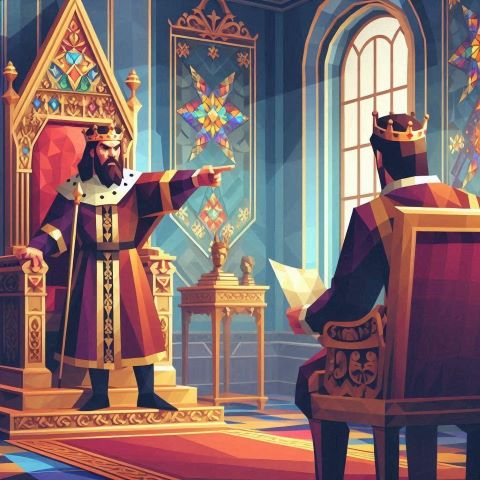
Image by Bing Co-Pilot AI. Prompt: A king in an ornate throne room, standing before his throne, angrily pointing out of the room, ordering a messenger to leave.
If you enjoyed this post, consider signing up for my newsletter on Substack and get each entry as it’s published. Thank you!
I was a teenager when the knock sounded. We weren’t expecting anyone. I answered. Two kids were in my front yard on their bikes. I was immediately suspicious. I knew them from High School. I wasn’t friends with them, but I didn’t like them. I didn’t hate them or consider them enemies, but they were enemy-adjacent: friends with other kids I actively disliked.
We’ll refer to them as Messenger and Assistant.
“Martin is talking crap about you,” Messenger said. Martin was another kid from high school, in the same category as these two: enemy-adjacent.
“Oh, is he?” I asked.
“Martin says he can beat you up,” Messenger said.
“Really?” I didn’t trust these guys, and I didn’t like them. I felt the pressure, and I gave in.
“Take me to him.”
As I walked behind the kids on bikes, I looked back toward my house.
My mother had arrived at the front door. She knew these neighborhood kids and their reputations. She stood on the porch, worry on her face. The scene was a Hollywood cliché: the mother watching fearfully and helplessly from her home’s stoop as her prideful eldest son foolishly walked off to defend his honor.
Along the way I questioned what I was doing. I was fully aware I was giving in to peer pressure, even as I was buckling under it. I didn’t care about what any of these dopes thought about me, or what they said.
Meanwhile, Messenger scolded Assistant and demanded he lend me his bike. “So he’s not tired for the fight,” he reasoned. Assistant refused. I shrugged and walked alongside them. It wasn’t far. A few minutes later, we were at Martin’s house. He was standing in his yard.
“Hey,” I said to Martin. “I heard you were talking trash about me.”
“I wasn’t,” he said.
“Yes, you were,” Messenger said.
“No, I wasn’t,” Martin insisted.
Messenger and Martin bickered.
“Oh. Well don’t,” I said, and I left.
I was annoyed at the whole situation, but mostly irritated with myself. On the solo walk home I thought about the stupidity of it all. I didn’t care if any of them had been talking trash about me. Why should I care when it has no effect on me, and I am not even aware of it? I had no desire to fight him, even if I had correctly assessed him as a douche.
The real villain in this whole scenario was Messenger: The leader of the two kids who came all the way to my house, interrupted my day, to inform me of something I would never have known had he not put out that effort.
Martin’s bravado would never have affected me. Yet Messenger went out of his way to inform me of something that would anger me. It was the first time I had encountered that creature that walks among us: the pot-stirrer, the trouble-maker.
The cliché is “don’t blame the messenger.” But like so many clichés, it shouldn’t be taken as an absolute, but applied wisely. In this case, the Messenger was the villain. But not all messengers are. Let’s discuss.
Don’t blame the messenger. Except sometimes, blame the messenger.
Cute story. Why share? Because I want to add to the current alerts against bad info. Right now there’s plenty of warnings against online communication. Watch out for bias, for misinformation (accidentally wrong) or disinformation (intentional lying.)
The point I want to add is, be mindful of what it is doing to you.
What is the information you consume doing to you?
You can’t be sure of others’ motivation for what they tell you or the accuracy of the info. But you can easily track how it changes your actions and your moods.
What were those annoying kids who tried to lure me into a fight trying to do? I don’t know. Maybe they were bored, didn’t like me, or they didn’t like my “opponent,” or they didn’t like either of us. Whatever it was, it wasn’t something for my benefit. While I was aware of what they were doing and I disapproved, I still went with it.
What I wish folks drawn to Fox News and its clones and as a result turned into — or exacerbated as — embittered angry folks would focus on is what Fox is doing to them. Fox is angering you for its own agenda. But it’s not just Fox. It’s any source of info.
All communication is some form of manipulation.
All communication is some form of manipulation. What is it doing to YOU? I’m writing this to convince you (manipulate you) into thinking that you should be wary of what news does to you. Less effort on trying to gauge if a communicator is sincere. More effort on what your reaction is to it.
I’m not saying hide from bad news. I’m saying don’t wallow in it. Do I need to hear over and over and over and over and over and over the same info about some horrible disaster? I heard ya the first time. Otherwise, I’m absorbing something that makes me mad or sad and I can’t change it.
Justice Gone Weird: If Not You, Who?
You can lose anyone to any source of info: news, cults, etc. Even to causes of justice. Another quick anecdote: A while back, I went on a binge of donating to good causes. At the time, my heart was deep in the cause of animal rights. Cruelty to animals hurts me like few other evils. I donated what I could.
What resulted from that? More mailings from more groups requesting money. Each day I went to my mailbox I could count on another letter with a photo of an animal suffering. As I attempted to defeat animal suffering, I saw it more and more. It got to the point where it was depressing. But should I look away because it upsets me? Or because it upsets me I should donate?
But I already had donated. I was told it was up to me. If not you, then who? That’s a lot of pressure to put on someone. It can be a spur to action: I must do my part! It can also be auto-defeating: I didn’t fix this problem, therefore, I have failed. All my actions meant nothing.
image created by DALL-E AI
Hordes of Dog-Biting Men
The old saying is “News is Dog Bites Man not Man Bites Dog.”
That may have been the case when news was a single, optional thing throughout the day.
It’s still optional, but less so. Existing in modern America it’s hard to dodge news that’s big enough. You can even overhear it all. If news is Man bites Dog, then people exposed to endless news cycle will think there’s hordes of dog-biting men roaming the streets. And based on some of the conspiracy crap floating around, it seems that’s the least crazy of their beliefs.
Watching the news too often skews your perspective. But it’s also the only way for us to get news from across the world.
What should NEWS be?
The “meta” of the news is what’s important to talk about. The channel itself is telling you what should be thought about and debated. CNN tells you you should think about the war machine and Wall Street. Fox News tells you should think about culture war stuff (aka “anything new is stupid.”)
There has to be a better way to “news” I’m not sure what it is, but until I find it, I’ll be carefully watching its effect on me. Especially as it sustains or reduces my endurance in supporting important causes.