Author: Larry Nocella

  • How You Can Subvert a Trump-Like Boss

    How You Can Subvert a Trump-Like Boss

    Surely everyone has worked for a jerk before, but I feel my travels through that universal experience contain an extra value. See, an executive that I worked for years ago (we’ll call her Jessica, not her real name) was extremely similar to current USA President and Wannabe Dictator Donald Trump. 

    Their behaviors, their attitudes, their quirks, etc. were so similar that not only am I experiencing Trump’s current awfulness, I’m also enjoying some PTSD. Every time the latest Trump sleaze BS hits the news waves, I think, “I’m not surprised. He’s just like Jessica.” 

    It’s not all pain, though. I remember how much I learned about stealthy resistance. I am certain that at this very moment, some in the federal government under Trump’s reign of babbling idiocy are exploiting the same flaws I and others exploited while working for Jessica, in order to do good work, and make the workplace something other than a living hell. 

    I feel by sharing the tactics I and my allies used, we can not only provide the universal skill of dodging clown managers but also provide specific ideas for anyone in the federal government who isn’t yet resisting with ideas and tactics that they might be able to use. Let’s begin.

    Awful Boss Stat Comparison

    Like Trump, Jessica was from the New York area and embodied many of its worst stereotypes. She carried arrogance with a lack of skill to back it up. Her main tool was shocking rudeness and meanness. She felt her high-level position meant her commands were not to be questioned. She wanted respect without earning it. 

    But don’t take my word for it. Here’s a brilliant script written by a pal (you know who you are!) who wanted to illustrate what it was like working for Jessica (and surely describes what it’s like working for Trump). 

    JESSICA: (Points at a yellow object.) This is red.
    WORKER: Okay, it’s red.
    JESSICA: No, it’s blue.
    WORKER: Okay, it’s blue.
    JESSICA: No, it’s green.
    WORKER: Okay, it’s green.
    JESSICA: No, it’s red.
    Repeat.

    Also matching Trump, Jessica had no desire to learn or listen. She had no vision beyond expanding her own tiny empire. Leadership qualities like helping others thrive were non-existent.

    When we underlings enforced company policies, requiring someone to change a work order. If that person was a friend of Jessica’s they would call her. She would override us and make an exception, effectively wasting our time and making us look like we didn’t know what we were doing.

    Let’s just bullet point the other similarities…. 

    • We were often given tasks with no clear purpose
    • We were often busy to create the illusion of productivity
    • We were managed with erratic behavior, no clear objective, no forethought, no follow up
    • We were told to never apologize, no matter how small, obvious, and public the error

    A strain of hallucinatory paranoia ran through her every decision. She seemed to truly believe others were spending all their time trying to make her look bad. Really, she was doing that just fine on her own.

    Okay. I’ve made the case. She was very Trump-ish. Now on to the resistance tactics. 

    Managing Your Manager

    My immediate manager, thankfully a shield between myself and Jessica, taught me a concept: “Managing your manager.” I don’t know if it was her original idea or someone else’s. But it’s damn good career advice, even if your manager is decent. Know your manager. Know their tendencies and work with them.

    Or around them. 

    With Jessica, like Trump, because there was no reflection, no vision, no guiding principles, and no real ability, managing her – and even better, manipulating her – was easy. 

    Small minds only think about things that affect them, what they see in front of them, and whatever fantasies they imagine. You can’t do much about that last one, but usually if they don’t see something, and no one reminds them, chances are good they will forget about it. They won’t touch it, address it, or try to bring it under their influence. Which means it will be safe to flourish instead of wither under the rot of their touch. 

    Yes, a terrible manager has lots of bad ideas, but often you can just ignore them and they will never follow up. They never say, “How are we progressing with that pointless errand I told you to do yesterday?”  Always remember that. Be quiet, don’t bring up something and it likely won’t be brought up. 

    Find Allies Who Will Provide “Air Cover”

    You are not alone. There are others around you who agree that what is going on is unacceptable. Do your best to find them by noting eye movements (involuntarily eye rolls) and body language. While I was working for Jessica, it was easy to feel alone with thoughts of, “Is anyone else seeing this stupidity and/or corruption?”

    Then a supervisor between us on the org chart implemented a program where we could work from home one day a week. He demanded it be kept secret and said frankly to his assembled team, “She (Jessica) cannot find out about this. If she does, the whole thing will go away.” He was leaving unsaid that he would get in a lot of trouble, too. He stuck his neck out in a smart calculated risk, improving morale despite Jessica’s best attempts to destroy it. The program lasted until my last day. I can only conclude she never found out.

    Forcing Things on Record

    Jessica was very hesitant to use email. Though I can’t know for sure, this was either because she would not admit she didn’t know how or she refused to learn anything new. Likely both. It’s also possible she knew she contradicted herself, but self-reflection was missing in her skillset. 

    Only after repeated requests could anything be put to any sort of record. We often pushed for it so we could go back and say, “But you said this.” Obviously, this led to awkward moments where she couldn’t deny regularly going against what she had previously said.

    We would be professionally persistent in demanding a record of assignments before such assignments began. We would express an interest in efficiency and preventing duplicate work and use other corporate buzzwords that even entry-level employees know are smart goals. We would write it up and ask, do we have this right? She would confirm and then she’d be locked in. Ha! Got ya! 

    The Fall of Mediocrity 

    Just to conclude this tale with its real-life happy ending. Eventually there were rumors that layoffs might be coming. My desk was close to the office of Jessica’s boss. She was summoned and left the door open. I could hear tense whispering. I couldn’t make out the words but I could tell Jessica was mad! That always made me smile.

    The meeting was brief. Jessica bolted from the office and yelled back over our heads, something like, “I guess I’ll just take a vacation!” As far as I could tell, I was the only one who understood the reason for the outburst.

    Because that’s when I was sure the layoffs were coming. It was just a question of when. The next day they hit gen-pop. There was a lot of crying and hugs and all that good stuff. I ended up being rehired at the same company with a better job and a far better manager. Jessica never returned.

    How it All Ends

    Despite all my dislike here, I would be lying if I didn’t say that toward the end, Jessica did seem to sort of maybe kind of perhaps get the idea that she was a jerk. There were some small but noticeable changes in her many bad behaviors. But it was far too little, far too late. 

    In the end, true power had spoken. The invisible decision makers with their hands on the levers of cash flow had issued their rulings. 

    I suspect that’s how the Trump era will end as well. The true power (the super-duper-wealthy invisible decision-makers behind even the visible billionaires) are going to say, “Okay, this little project is over. We’ve squeezed all the juice from this rotten, wrinkled orange we can get. The people are ready to riot. Let’s put all the blame on him before the people blame our system.” 

    But who knows? 

    In the meantime, manage your manager. Say yes, but do no.

    Image with this article generated by Chat GPT AI with this prompt: a cartoon drawing. an overbearing manager stands over a worker at a computer terminal, screaming at the worker. the worker cowers in his seat
  • Book Review: Martyr!

    Book Review: Martyr!

    I’m not usually a literary genre person but I saw the hype about Martyr! by Kaveh Akbar and gave it a try.

    PROS: Interesting perspective of Iranian man. He comes to the USA and has common problems (fitting in as a gay man, battling addiction, struggling with injustice.) The repeated mentions of the US Navy shooting down an Iranian civilian flight is a good reminder about that crime.

    CONS: No real drive to the plot. I get this is a side effect of the literary genre, but it was too heavy on the introspection. That’s a minus for me. Internal anxiety and dissatisfaction I can supply all my own. I don’t need an artist for that.

    SUMMARY: The book held my interest long enough so that I finished. High marks for that, and pat on the back for me for open-mindedness.

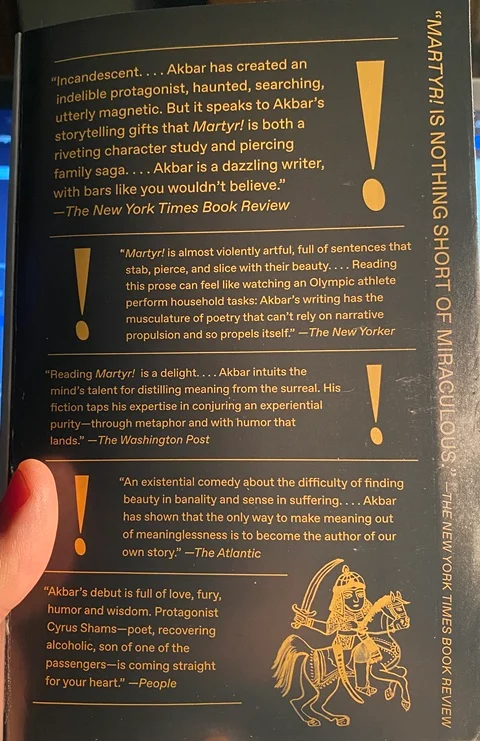
    The biggest minus of all for this book? The book reviews plastered all over it. By The Holy Algorithm, they were over-the-top. “Nothing short of miraculous,” said the NYT Book Review. The New Yorker out gushed them with this gem: “Reading this prose can feel like watching an Olympic athlete perform household tasks.”

    And those are the tamer ones. Are they auditioning to be the president’s press secretary?

    book reviews from Martyr! by K. Akbar
    Too much hype! Book reviews from Martyr! by K. Akbar

    But opinions are subjective. There’s no convincing someone who likes something that they shouldn’t like it. But I will try. As I said, the book shared a new perspective for me. Great! That’s what books are for. But I’ve already forgotten how it ended and a lot of what happened.

    The breathless reviews are too much. Such a precious approach might be as dangerous as book burnings and censorship. Hype cranked to such absurdity raises a reader’s expectations so high, no work can match it. A new reader thinks, “Well, if this yawner is what they call great, I guess I don’t like reading.”

    I’m a book-lover but after wading through the gushing reviews to the first page, I couldn’t help but shriek, “It’s just a book, okay?!”

    Yes, there’s some poetic lines but overall, it’s a basic story with a single twist toward the end. That’s it. Decent enough to finish, good enough to enjoy, but calm down.

    Or don’t. You’re welcome to your opinion and I’ll retain mine. All that insane hype makes my eyes roll with such intensity it’s got to count as a calorie-burning workout. So, thanks, I guess. I’ll have to make an effort to skip cover reviews going forward — they damaged the experience of a sensitively written book. Then again, it was the hype that caught my attention. In the end, as usual, I’m partly to blame.

    Book Review: Martyr! By Kaven Akbar – link to Amazon here: https://amzn.to/3EMzEP4

    =================

    BONUS: All this annoyance at literary hype has put me in a mood to re-read this classic: A Reader’s Manifesto: An Attack on the Growing Pretentiousness in American Literary Prose by B. R. Myers. (Amazon link: https://amzn.to/410l6CW) That book is 20+ years old but still applies. Book hype hasn’t changed.

  • The War on Christmas Is Over! Bring on the Toilet Wars! 

    The War on Christmas Is Over! Bring on the Toilet Wars! 

    The Jerkiest of Jerks

    It’s no secret this world is full of jerks. Jerks of all kinds. At the top of the scale, the jerkiest of the jerky, are those that exploit kindness. I mean those who pretend to be in distress, then when a passerby tries to help, the criminal strikes, robbing (or doing something worse to) the kind soul. 

    Those goons achieve peak jerkitude because they not only harm their victim, but they create a world frightened to help out a stranger. They steal kindness from us all.   

    That is why I hold a special place of distaste for Bill O’Reilly. Who? 

    Younglings may not remember this clown, but for a while, he was a popular example of that awful breed, the Culture Warriors. He was that type of person — a type that sadly has become more numerous — who complains about things that are individual choices and really none of anyone else’s business. Or they complain about entertainment and entertainers, trashing people and events with no genuine civic power. 

    Fake Culture Wars vs Real Class Wars

    In my mind, it was Bill O’Reilly who started – or at least made popular – this idea that there was a War on Christmas. A laughable idea, being as the instant Halloween decor comes down, Christmas songs begin.

    O’Reilly complained about people trying to enforce the sensible separation of church and state, as evidence of a nefarious attempt to eliminate Christmas entirely. I believe he did this for the same reason anyone hypes a war: to make money, and to gain power. There is also the benefit (for those who seek to rule) of distraction from real life-impacting issues.

    The same playbook is in use today. If you create a culture war, you can get people to side with you even if you do nothing for them. People will vote against their own interests if they believe they are fighting on the correct side of an imaginary war.

    Despite being fake, the War on Christmas does real damage in the real world, just like those jerks I mentioned in the beginning. Ever since Bill O’Reilly used his cable news pulpit to hype this bogus war, now every year I see people announce on social media how they will defiantly say “Merry Christmas!” no matter who tries to stop them – despite the fact that no one has ever tried to stop them. Then you also have people explaining why they prefer to say Happy Holidays (because there are multiple holidays at the end of December, because you don’t know a person’s religion, etc.) 

    The entire concept of a War on Christmas has made people hesitant about wishing others well, or feeling they have to justify sharing kind words because they somehow might not be the right kind words. Words of good cheer were turned into a battle cry.  

    The Hell of Wishing Well 

    The result? Today when I wish someone “Happy Holidays!” a thought sprints across my brain, “Is this person a Christmas Warrior who will manufacture offense at my sincere desire for their happiness?” In short, like the fake-distress bandits, the War on Christmas has made me pause before wishing someone happiness. 

    This world needs people encouraged to share kind words, not discouraged from doing so. 

    To all Christmas Warriors out there, turn this around. Many times in my life, you have said to me, “I’ll pray for you.” How would you feel if I flipped out and answered that with, “How dare you! I’m an atheist! You should just HOPE for me!” You would be confused and hurt, and rightly so. You would think, “How rude! Praying is how I show you respect. I’m wishing you well.”

    Exactly.

    The New and Improved Battleground: Toilets 

    Let there be peace on earth and let it begin with me. Let this be the last one. I declare the war on Christmas over and done. We all lost. Borrowing from Christopher Hitchens, if a war can be started with an imaginary declaration, let it be ended with the same ease. The good news is, the War on Christmas seems to be losing steam as a culture warrior tactic. It’s just gotten too old to get working class people out to vote for rich people who steal from them. 

    The bad news is that I believe this is why we’re seeing a ramping up of the Toilet Wars. That is, arguments over where a trans person will privately drop their waste. This is the younger, sexier, new and improved culture war taking the spotlight. 

    It’s got everything a good culture war needs: imaginary problems, things that bother no one unless they buy in to one-in-a-trillion type scenarios that have never yet happened, distraction from important issues, and even better, it can be argued year-round. Early-adopter ethics-free charlatans are already fighting the Toilet Wars relentlessly, gathering fame and converting that fame to cash. 

    We couldn’t stop the last war, but we can recover. Let’s fearlessly say kind things to each other and enjoy when someone shares a kind word — even if it’s not our word.

    And as for which toilet someone uses? Let’s not give a crap. 

    Image by ChatGPT AI. Prompt: A cartoon illustration of Vietnam-war era soldier emerging from a toilet bowl, surrounded by Christmas lights.

  • An Upgrade is Available for Your God(s)

    An Upgrade is Available for Your God(s)

    The more I write about tech, artificial intelligence, and algorithms, the more I sound like I’m talking about religion.

    Estimated reading time: 5 minutes

    Humans Need to Know Why

    Like many folks in this era of podcasts, I have listened to far too many true crime stories to be healthy. 

    There is one thing I find extremely fascinating about the families of the victims. They’ve expressed a common feeling that’s surprising, when the full fate of their loved-one isn’t fully known. Say a person has gone missing, evidence indicates they were likely murdered, but their body is never found, and the details are murky, the suspect isn’t talking, etc. 

    These poor folks will often say something like this, “Not knowing is the most difficult part. I would rather know that he’s dead than just not know anything.”

    To me, that is an amazing statement. 

    These people, suffering at an intensity most of us will fortunately never know, say they would rather have confirmation that their loved one is deceased – rather than simply not know the horrible details of what befell them.

    I’ve heard it over and over from the victim’s surviving families. Suffering a list of horrible emotions, they all say not knowing is the worst of all. 

    It’s common to us all. We humans hate not knowing. We are curious and we need to know why. It’s hard to reduce the evolution and success of our species to a more compact phrase. 

    Gods and Tech Upgrading in Sync 

    Our need to explain why things happen is so powerful that to relieve the agony, we’ll make up stories to explain it. Yes, I’m talking about religion right now, but the need to have a clear why applies in many other areas. It explains the popularity of fact-free conspiracy theories, and much more.   

    Of course, what feeds our explanations (fact-based or not) of why things happen are the ideas around us, is the current technology. As technology upgrades, speculations of “Why?” changes in parallel.

    Early explanations of the unknown didn’t involve much tech. Everything simply had a spirit that animated it.  

    Then came Gods – the “alphas” of a tribe. They mirrored the ruling caste of growing bands of humans. Then God became a singular king-like being who ruled over mortals, since kings were the most powerful earth-based beings.

    Now, in this computer age, we are seeing the emergence of upgraded “god theories” that match the currently most advanced technologies. God is an artificial intelligence, a computer, life itself is a simulation, etc.

    As technology becomes a bigger part of people’s lives, I hear the same language in the explanations of how the mysterious algorithm works, as are usually used to describe the mysterious will of God.  

    The Mysteries of The Algorithm

    While discussing the whys of algorithms, you’ll notice the same ideas and events that occur when people turn to religious thought. Where there is the unknown, there will be a rise of prophets who claim to have the answers, claim to have the ability to influence the algorithm (or God) and they will gladly share their knowledge — for a price.

    On a writing forum recently, a person complained they were posting plenty of content on a social media platform but not gaining many followers. It’s well-known now that social site algorithms respond to “engagement.” Just posting isn’t enough. To get approval from the algorithm, you need to reply, like, and share others’ posts as well. Here was my suggestion to the would-be influencer: 

    The Mighty Algorithm rules all. You are not sacrificing enough of your time for it to consider returning your gift. You must interact with others and increase your holy engagement. Only then shall ye be rewarded. 

    I wrote it that way because it seemed the same solution offered in ancient times to influence the gods: make a decent enough sacrifice to increase the odds of them heeding your prayers.  

    I’ve joined in this new angle on the same old religion with phrases such as –

    • Praise the mighty algorithm – may it bless my content.
    • O, holy algorithm, I pray you use your mysterious powers to guide this post to many likes. 
    • Glorious algorithm, I have spent this last hour on your platform as sacrifice. Please now promote my influence.

    I’m not freshly converted, I just figure if we’re going to use religious-like talk about the algorithm, we may as well make it sound more official.

    And while I sound here like my tone is above it all, or sarcastically playing the newly converted, let me clarify. For I do know the true way to manipulate the gods old and new. I do indeed know the spell, the incantation.

    There is one certain way to earn the favor gods digital and human… pay cash. 

    The One True God 

    Yes. That is my secret to manipulate the mysterious algorithm. I pay as little as possible for the cheapest ads I can afford — that will drive visitors to my books on Amazon.

    A tribute to the real god behind all gods always works and always has worked. Because if there is one true god across all facets of humanity, it’s money. (For my fellow 80s kids, yes, the film They Live got it right.) 

    That type of tribute, that sacrifice, has reliably worked miracles for as long as there have been humans to wonder how to manipulate other humans.

    I think the parallels between mysterious algorithms and religion tie up neatly in this final revelation. What we often call the unknown mysteries, or the motivations of a divine being are often just other mortals, hiding their knowledge, pulling hidden levers, and presenting a show. All to control a man-made system but make it appear divine.

    As ever, what appears the presence of a mystical force is just someone putting their finger on the scale. They are easily and reliably moved with a tithe.  

    Image generated by Chat GPT A.I., prompted by the text of this essay.

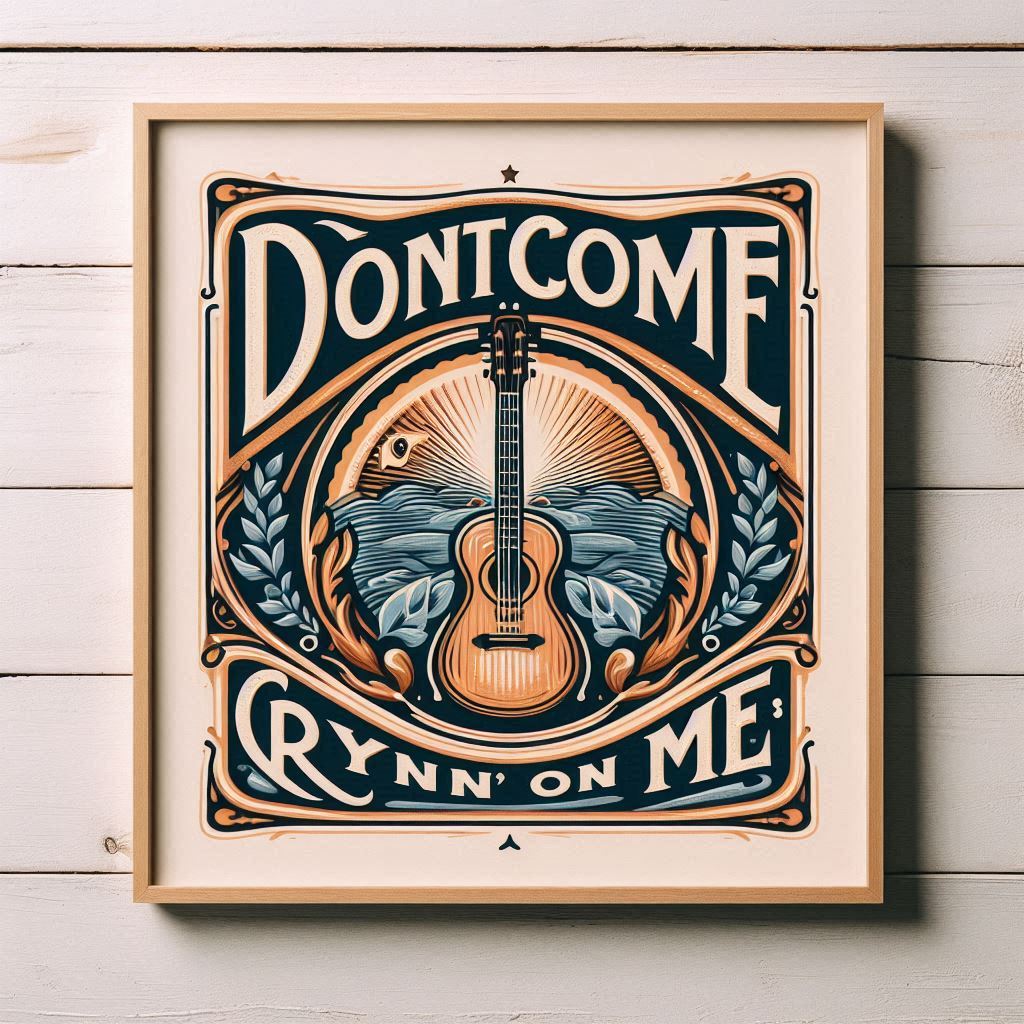
  • A “Don’t Come Cryin’ to Me” Kind of Moment

    A “Don’t Come Cryin’ to Me” Kind of Moment

    USA Election 2024 is over. If the obvious happens, I don’t want to hear from you.

    Estimated reading time: 3 minutes

    Okay, friend, so you voted for Trump. This might surprise you, but I get it.

    I really do. Times are tough. You got tired of it. So, you voted for change. If you had any concerns beyond your own, you set them aside because life is hard. No doubt. Totally agreed, life is rough.

    My concern is this: I follow politics and study history, and what I’ve learned is that a different path doesn’t always mean better. It can mean far worse. But okay, fine. This is what you want. Out of respect for you and your choice, we do it your way.

    And while I am a professional smartass, and don’t hold back my criticisms often, I do try to love others. I really do. I try to love everyone — that includes you, of course. So, it stings me a little, but I have to say…

    Don’t come cryin’ to me if –

    • Food prices go up because the immigrants who farm it have been expelled
    • There’s chemical waste in your food because the FDA has been dismantled — too many regulations to make food safe also cut into profits
    • Same with air quality and the EPA
    • Health insurance denies you coverage you paid for because of a “pre-existing condition”
    • The women you love have complicated pregnancies and can’t get the care they need because a doctor is afraid it will get described as an abortion — whether it is one or not
    • You or people you love are deported for being “immigrants” — whether they are or not — or their years in the country do not go back far enough
    • Your hard-earned 401k gets converted to Cryptobucks and becomes essentially worthless
    • You get a school voucher for $500 to pay for your kids’ school, but tuitions all start at $10,000
    • Full retirement age is raised to 85 so the government can lower taxes, but now it has no money to pay you back for your years of work
    • The cost-of-living goes up because the president doesn’t bother to learn how tariffs work.
    • The person who committed crimes against you and your loved ones gets rewarded with praise and a promotion.

    Oh, they won’t do all that, you say. I hope you’re right. I really do. But it’s not the ones in power we have to fear as much as the ones behind the “throne.” And those folks, wow. Some of them are real monsters.

    But, okay, fine. You say I’m mad because I lost the election. Not really. I’ve lost elections before. And as I always say, out of respect for others, I accept they chose differently.

    My biggest fear is for you. I’m afraid that — even if I wanted to — I won’t have to tell you to go fuck yourself, because soon it will be apparent to you that you fucked yourself just fine. The problem is, I fear you might have fucked the rest of us, too.

    But — we’ll see. As usual, I hope I’m wrong.

    P.S. I’m not entirely truthful here. You can always come crying to me if things go bad. As much as I can, I’ll help a stranger and a friend, even if I think they got themselves in a bind through their own mistakes.

    That’s just how I am.

    ===

    If you made it this far, thank you for reading. Am I being to pessimistic, anything to add to the list of “Don’t Come Cryin’ to Me?” Share your thoughts. If you want, share this post. Or don’t. But have a good day and please be kind!

  • Am I a Fool for Loving Generative A.I.?

    Am I a Fool for Loving Generative A.I.?

    If Generative A.I. Is Wrong, I Don’t Want to be Right

    Estimated reading time: 6 minutes

    I don’t remember much about grade school, but I clearly recall a classmate’s kindness. In art class, this one kid made drawings that were always fantastic. Mine were always less than. Far less than. I asked him his secret, expecting him to keep such valuable knowledge to himself. 

    He shared generously and without hesitation. “When you fill in a shape, make sure you color in the same direction.” 

    During our next art class, I tried it. The result? My drawing still looked terrible and his still looked amazing.

    That was my first lesson in talent. He was skilled at something, and I wasn’t. I could work for it, but it seemed far too much work.

    I would spend my years envying visual artists of all kinds and their ability to create astounding imagery.

    Sufficiently Advanced Tech 

    Fast forward to today. Along comes generative A.I. DALL-E, Adobe Firefly, Bing Copilot, and so many others, and it feels like a miracle. Because with those tools, so simple, so powerful, so fast, I can draw! I CAN DRAW!!!!

    Correction. I still can’t draw, but I can generate visuals that without that software, I wouldn’t be able to create in a thousand years. That frustrated kid from grade school, who couldn’t draw as well as his classmate even as his mate helped him, has waited for decades and now, finally, finally, finally, I can create art!

    Like Arthur C. Clarke’s brilliant observation: any sufficiently advanced technology will feel like magic. To me, generative A.I.’s image-making abilities feels like something mystical.

    The A.I. Mindset 

    I’m sharing my very positive experience with generative A.I. because I feel compelled to stick up for my friend. A.I. isn’t all bad. Not by a longshot. It could just be my filter bubble, my self-trained algorithm, but it seems like the negative aspects of A.I. get most of the hype. 

    Even when A.I. existed only in our imaginations, there were warnings about it. Science Fiction authors alerted us to the dangers long ago.

    Maybe you’re one of these A.I. haters, annoyed that I like A.I. for what it can do for me. 

    “You could have developed your drawing skill,” some might say. “You could have practiced hard and worked at it.”

    Yes, I know. Instead of saying “I can’t draw,” I’m supposed to say, “I can’t draw… yet.” I know, I know. I too read Carol Dweck’s superb book Growth Mindset (affiliate link) that explains that thinking in depth. Yes, that’s the right attitude.

    If I work at it, I could be a visual artist without A.I. Had I worked at it, I would be one already. Maybe. But it would have taken years upon years upon years of training and practice, years I don’t have and years I don’t want to have. I dedicated those years to writing, and I want to dedicate the years in the future to writing. 

    Now I have a tool that can take a visual idea and make it happen. That is incredible! I love it! 

    A Dangerous Optimism

    “Well sure,” our imaginary hater might say, persisting in this argument, “It’s not your trade that’s being overrun by A.I. That’s why you like it.” 

    Um, actually! My trade (writing) is in just as much danger, if not more. A.I. can write, too. I’m not afraid of it though. What I’ve seen is rather lifeless. 

    Also, lifeless writing created by humans gets published all the time. Further, I see it A.I. as a challenge – it will push me to be even more creative, to achieve, as I’ve said before — something so real it can’t possibly be created by A.I. I’m already competing with millions of faceless writers online, what’s a few million more?  

    Besides, what if my artist pal from grade school had the reverse problem? He can draw, but what if he had (and still has) trouble assembling words? He may be just as thrilled about generative A.I. as I am, wherever he may be. 

    So just because it doesn’t affect me doesn’t mean it’s okay, which is the tentative guilt I feel at loving A.I.

    Forbidden Love

    I am torn when I express my love for Generative A.I. On the one hand there are people I trust saying it’s dangerous. 

    On the other hand, there are people I don’t trust (the techbro douche-o-sphere) hyping every tech advance with religious fervor and causing mayhem. Lately they’ve been rebranding everything as A.I.-powered to keep that investment cash rollin’ in, even if it’s as “A.I-Powered” as a standard phone voice tree. 

    And so, going against people I trust, I wonder, am I allowed to think that A.I. is cool? Amazing? Am I allowed to love it? Or am I embracing our doom? Am I being naive? Is my dangerous optimism leading me wrong again? 

    Yes, I understand that A.I. can be a danger to creativity, it can be a danger to those who make their living creating astounding imagery all on their own. No, I don’t know where A.I. will take us as a society, as a species. Probably the usual mix: more horrors, more wonders. 

    If I could bring it back down to my tiny world, I’m just glad it awakened that kid in me who wanted to draw, forgot he even cared about it for decades and now suddenly, he can. 

    Imagination at Play

    A.I. is a tech marvel. There are complex issues that affect people’s lives, our civilization, our whole species. 

    That’s all true, but just for a moment, can I simplify? Can I say I love generative A.I.? Can I admit I recognize the dangers to people’s employment, and all that but I love it all the same. Just to play. When was the last time tech – or anything – came along and you played with it? Or marveled at its abilities as it filled you with ideas? 

    I’m still a kid in grade school with bricks for hands but still loving the feel of those chunky crayons. I feel like a kid on a slide for the first time, screaming “Wheeeeee!”  

    That’s how I feel playing with generative A.I. and making pictures. like every aspect of all our impressive gadgets, there’s some good things, some bad. 

    For now, I want to ignore the bad because the good isn’t just good. It’s magical. I just want to play.

    Image created by Bing Co-Pilot A.I. Prompt: a cute illustration of a boy wearing a propeller hat hugging a robot with hearts around their heads.