
Author: Larry Nocella

  • Hordes of Dog-Biting Men! -or- Lessons Learned About News Bias and Disinformation From a Fight for my Honor

    Hordes of Dog-Biting Men! -or- Lessons Learned About News Bias and Disinformation From a Fight for my Honor

    Estimated reading time: 7 minutes

    I was a teenager when the knock sounded. We weren’t expecting anyone. I answered. Two kids were in my front yard on their bikes. I was immediately suspicious. I knew them from High School. I wasn’t friends with them, but I didn’t like them. I didn’t hate them or consider them enemies, but they were enemy-adjacent: friends with other kids I actively disliked.

    We’ll refer to them as Messenger and Assistant.

    “Martin is talking crap about you,” Messenger said.  Martin was another kid from high school, in the same category as these two: enemy-adjacent.

    “Oh, is he?” I asked.

    “Martin says he can beat you up,” Messenger said.

    “Really?” I didn’t trust these guys, and I didn’t like them. I felt the pressure, and I gave in.

    “Take me to him.”

    As I walked behind the kids on bikes, I looked back toward my house.

    My mother had arrived at the front door. She knew these neighborhood kids and their reputations. She stood on the porch, worry on her face. The scene was a Hollywood cliché: the mother watching fearfully and helplessly from her home’s stoop as her prideful eldest son foolishly walked off to defend his honor.

    Along the way I questioned what I was doing. I was fully aware I was giving in to peer pressure, even as I was buckling under it. I didn’t care about what any of these dopes thought about me, or what they said.

    Meanwhile, Messenger scolded Assistant and demanded he lend me his bike. “So he’s not tired for the fight,” he reasoned.  Assistant refused. I shrugged and walked alongside them. It wasn’t far. A few minutes later, we were at Martin’s house. He was standing in his yard.

    “Hey,” I said to Martin. “I heard you were talking trash about me.”

    “I wasn’t,” he said.

    “Yes, you were,” Messenger said.

    “No, I wasn’t,” Martin insisted.

    Messenger and Martin bickered.

    “Oh. Well don’t,” I said, and I left.

    I was annoyed at the whole situation, but mostly irritated with myself. On the solo walk home I thought about the stupidity of it all. I didn’t care if any of them had been talking trash about me. Why should I care when it has no effect on me, and I am not even aware of it? I had no desire to fight him, even if I had correctly assessed him as a douche.

    The real villain in this whole scenario was Messenger: The leader of the two kids who came all the way to my house, interrupted my day, to inform me of something I would never have known had he not put out that effort.

    Martin’s bravado would never have affected me. Yet Messenger went out of his way to inform me of something that would anger me. It was the first time I had encountered that creature that walks among us: the pot-stirrer, the trouble-maker.

    The cliché is “don’t blame the messenger.” But like so many clichés, it shouldn’t be taken as an absolute, but applied wisely. In this case, the Messenger was the villain. But not all messengers are. Let’s discuss.

    Don’t blame the messenger. Except sometimes, blame the messenger.

    Cute story. Why share? Because I want to add to the current alerts against bad info. Right now there’s plenty of warnings against online communication. Watch out for bias, for misinformation (accidentally wrong) or disinformation (intentional lying.)

    The point I want to add is, be mindful of what it is doing to you.

    What is the information you consume doing to you? 

    You can’t be sure of others’ motivation for what they tell you or the accuracy of the info. But you can easily track how it changes your actions and your moods.

    What were those annoying kids who tried to lure me into a fight trying to do? I don’t know. Maybe they were bored, didn’t like me, or they didn’t like my “opponent,” or they didn’t like either of us. Whatever it was, it wasn’t something for my benefit. While I was aware of what they were doing and I disapproved, I still went with it. 

    What I wish folks drawn to Fox News and its clones and as a result turned into — or exacerbated as — embittered angry folks would focus on is what Fox is doing to them. Fox is angering you for its own agenda. But it’s not just Fox. It’s any source of info. 

    All communication is some form of manipulation. 

    All communication is some form of manipulation. What is it doing to YOU? I’m writing this to convince you (manipulate you) into thinking that you should be wary of what news does to you. Less effort on trying to gauge if a communicator is sincere. More effort on what your reaction is to it. 

    I’m not saying hide from bad news. I’m saying don’t wallow in it. Do I need to hear over and over and over and over and over and over the same info about some horrible disaster? I heard ya the first time. Otherwise, I’m absorbing something that makes me mad or sad and I can’t change it. 

    Justice Gone Weird: If Not You, Who?

    You can lose anyone to any source of info: news, cults, etc. Even to causes of justice. Another quick anecdote: A while back, I went on a binge of donating to good causes. At the time, my heart was deep in the cause of animal rights. Cruelty to animals hurts me like few other evils. I donated what I could.

    What resulted from that? More mailings from more groups requesting money. Each day I went to my mailbox I could count on another letter with a photo of an animal suffering. As I attempted to defeat animal suffering, I saw it more and more. It got to the point where it was depressing. But should I look away because it upsets me? Or because it upsets me I should donate? 

    But I already had donated. I was told it was up to me. If not you, then who? That’s a lot of pressure to put on someone. It can be a spur to action: I must do my part!  It can also be auto-defeating: I didn’t fix this problem, therefore, I have failed. All my actions meant nothing. 

    image created by DALL-E AI

    Hordes of Dog-Biting Men

    The old saying is “News is Dog Bites Man not Man Bites Dog.” 

    That may have been the case when news was a single, optional thing throughout the day.  

    It’s still optional, but less so. Existing in modern America it’s hard to dodge news that’s big enough. You can even overhear it all. If news is Man bites Dog, then people exposed to endless news cycle will think there’s hordes of dog-biting men roaming the streets. And based on some of the conspiracy crap floating around, it seems that’s the least crazy of their beliefs. 

    Watching the news too often skews your perspective. But it’s also the only way for us to get news from across the world.  

    What should NEWS be? 

    The “meta” of the news is what’s important to talk about. The channel itself is telling you what should be thought about and debated. CNN tells you you should think about the war machine and Wall Street. Fox News tells you should think about culture war stuff (aka “anything new is stupid.”)

    There has to be a better way to “news” I’m not sure what it is, but until I find it, I’ll be carefully watching its effect on me. Especially as it sustains or reduces my endurance in supporting important causes.
  • What I Learned From Catching a Foul Ball With My Butt

    What I Learned From Catching a Foul Ball With My Butt

    Estimated reading time: 5 minutes

    Surrendering to the Common Wisdom

    Being non-conformist should be done wisely. Many have observed before that if you just think the opposite of something on reflex, you’re just as confined as a conformist. You’re “conforming to the non” as I like to put it.

    Still, there are some clichés, some bits of common wisdom, that I resist because of their pessimism. For example, one cliché I don’t like – but I have to acknowledge is true – is, “Life isn’t fair.”

    I used to hate the idea of calling life unfair. It just seemed so… unfair. I tried to say that it was people that are unfair, not life, but that’s wrong. Some people are born with horrific diseases, that’s not the fault of optional human action. That’s biology. That’s life.

    Fine. You win. I lose. Life is unfair.

    Now when it comes to calling life unfair, I burn with the passion of the converted. I look back at my ultra-naïve youthful self and laugh with contempt: “You once believed in the Tooth Fairy. Even worse, you clung to the idea that life could be fair!”

    So what finally convinced me? What does this have to do with catching a baseball hit foul with my butt?

    Well…

    Getting What You Don’t Want

    I have realized life is really unfair because it seems to have this annoying tendency to give you things you don’t want, and keep things away from you that you do want.

    For this story, let’s review people’s tendency to lose their minds trying to catch balls that go out of play in major-league baseball games.

    There’s the story of a man who fell and died.

    There’s a guy who almost died.

    There’s a woman who stole a ball from a child.

    There’s a guy who dropped his child as he went for a foul.

    There’s plenty more examples of injuries and bad behavior as people chase baseballs if you want to search for them.

    People really really really want to get their hands on a ball at baseball games. I don’t understand it, and never have. It’s fun, but not worth dying over, or acting like a horrible person. It’s just a ball. And that’s exactly why life, being the unfair jerk it is, delivered one to me with the greatest of ease.

    Catching a Major League Baseball Foul Ball

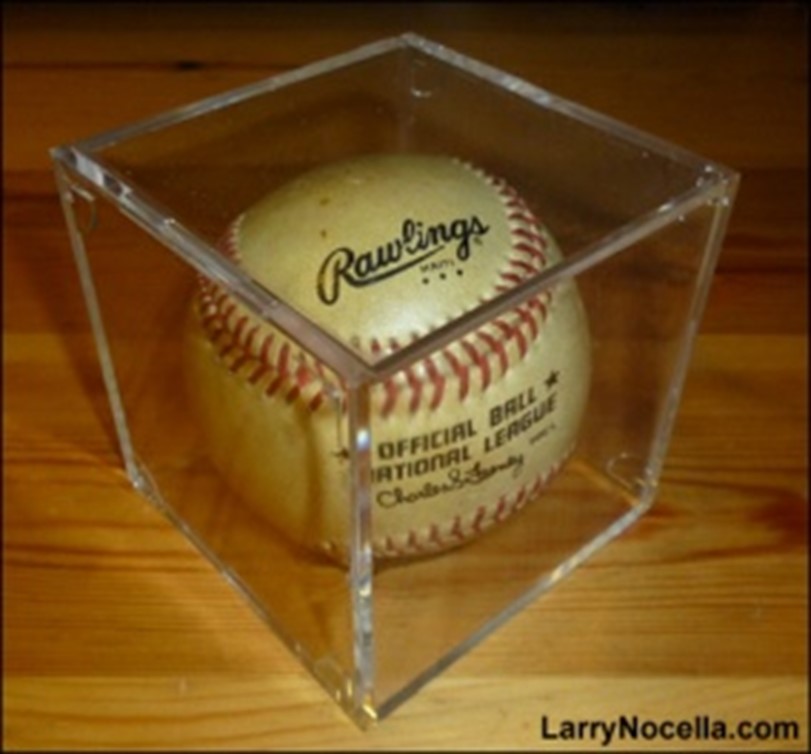
    Back in my early teens, my father scored some good tickets from his job. The seats were a couple dozen rows from third base for a Philadelphia Phillies game. It was a great day, just me and pop watching a daytime, weekday ballgame. I wasn’t that into baseball. Never was, but it was fun.

    I was bummed the game wasn’t televised. Being a kid, I wanted to be on TV!

    The date was August 9, 1983 [game stats]. Greg Gross [info] knocked a pitch foul. Everyone around us stood up. I felt confident it wasn’t going to come near me, but I stood up anyway, so as not to get hit in the head, just in case.

    The ball entered the crowd a few rows in front of me. Everyone was shoving and grabbing for it. The ball hit the back of someone’s seat and took a crazy bounce. The feeding frenzy was on. People scrambled and flailed trying to snag the ball. In the chaos, the ball tumbled closer. After a bunch of weird bounces off people, chairs and the cement of the stadium, just like that, the ball landed in my seat. I sat down on it.

    And that’s how I caught a foul ball with my butt.

    Totally awesome, right? Well yeah. It was fun and funny how it happened, and I felt lucky, but once the foul-hunters sat down again, I grabbed the ball and stood up with it triumphantly. That’s tradition! And it’s also customary to show the lucky fan on the jumbo screen! Now that was something I wanted. If I couldn’t be on TV, at least I could have that.

    But whoever was running the camera for the jumbo screen didn’t care to show me. People around went back to their seats, and the game went on. Dang it. But so what? You’re saying. You caught a foul ball! Years later a man would fall to his death in front of his son trying to get one!

    True, but I wanted to be on the jumbo screen! Life is unfair!

    Being Lucky in Ways You Don’t Want to Be and Unlucky in Ways you Want to Be Lucky

    After the game, I gave the ball to my dad. He’s the baseball fan. I’ve always been a follower of faster-moving sports, like… well, like anything. After years of my dad holding the foul ball he finally insisted I take it back. You caught it, he said, you should have it. And I still do. In a plastic box, that’s in a cardboard box, under my bed, under a fine layer of dust.  

    I can hear you now: you could sell it online. I could. Online sales have created a reason for people to collect anything and everything, because surely someone else will pay more for it than you did, even if it is intrinsically worthless. What’s that? No, I didn’t intend that as a critique of “investing” in gold, but yes, it does serve as one.

    Anyway, yes, I could sell the foul ball. I could even donate the money to charity, but I won’t now. It’s become a symbol to me: a reminder that life is unfair. That sometimes annoying clichés are true and that the grass is always greener on the other side.

    I think the trick is, for the things we want, we should pretend we don’t want them and sneak up on them. Then when life isn’t looking, we make a quick grab. But when isn’t life looking?

    It might just be easier to appreciate what we get, even if it’s not what we want. That’s a good defense against life’s unfairness.


  • Book Review: Excellent Sheep

    Book Review: Excellent Sheep

    Estimated reading time: 3 minutes

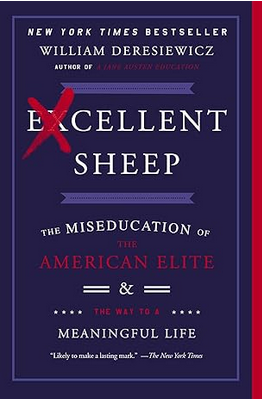
    As a proud college dropout, I was excited to read this. I also like the author, William Deresiewicz. I’ve enjoyed listening to him as a guest on podcasts and admired his analyses.

    Like myself, he has a deep love of learning. Unlike myself, he puts too much faith in the institution of college and that error haunts this book. I don’t like to be condescending, but at several points I wanted to ask, “How clueless are you, bro?”

    From my experience, if “The Academy” ever meant something, whatever noble values it offered are few, because those institutions were strip-mined to serve Capitalism a long time ago. 

    But I’m just one person with one perspective. Maybe during his day, or in his individual experience, college provided wonderful things. Good for him. I’m glad it enriched his life. But he seems to think that college functioning as an expensive form of young adult daycare is a new observation, when that was exactly how I experienced it decades ago – and why I left and never went back.

    Credit to Deresiewicz for being a rebel in his sphere, but that’s exactly the problem. Where are all the other professors expressing deep concern for university culture? They exist, but they usually wander off to join what I’ll call the “Cancel Culture Complainers Club.” You know them. They’re everywhere today. Their one and only song – that the book echoes – is a sad, ancient, familiar tune: “Kids today are lazy and don’t know anything.”

    The book hits a deep low when the author laments that students today don’t seek insight from the same old sources: Jane Austen, James Joyce, etc. and all these boring, awful literature works that supposedly are the only aids to think deep thoughts. I’m going all caps to make this clear: FUCK MRS DALLOWAY. No offense to Virginia Woolf, but this has happened to me before: elder folks tell me that the story of Mrs. Dalloway will provide me with insights that no cultural work since can.

    No. Utterly wrong. Maybe those books meant something to you but to the rest of us they suck. After this low-point, Excellent Sheep just gets lower as Deresiewicz starts quoting the conservative out-of-touch-dork-o-sphere (a.k.a. NY Times pundits David Brooks, Ross Douthat, etc.)

    Learning isn’t a one-size-fits-all thing. That may not have been clear in the past, but now, it’s obvious. I’m not saying the university is dead, but it isn’t the solitary place of learning. For folks who may be neurodivergent, or just not academically focused, there is no place for us in college-land.

    For some, maybe college was a place to find your “purpose” or for extensive learning. For me, college was a place where learning — and the passion for it – nearly died. For me, the best way to learn was to quit college.

    I can’t recommend this book except as an example of a well-meant critique gone wrong. There are few insights here. Just a lot of the usual older generational complaints that fail to realize the realities of others.

    There’s even a movement for people with successful careers and no degree: it’s called Tear The Paper Ceiling. I don’t know much about it, but I’m curious to explore more: tearthepaperceiling.org.


    As an Amazon Associate, I earn from qualifying purchases if you click the ad for the book and make any purchase. (No extra cost to you!) Excellent Sheep by William Deresiewicz at Amazon

  • Influencer Canceled in Record Time!

    Influencer Canceled in Record Time!

    The Epic True Tale of How I Became an Amazon Influencer and Was Canceled In the Span of a Week.

    Chapter 1: A Delightful Surprise

    Congratulations, Amazon Reviewer! You have posted so many reviews and earned so many helpful votes that we are going to promote you to Vine Voices: Silver Tier. What is that? It’s an Amazon program for our best reviewers! You order items that interest you at not cost! Shipping is free. You only need pay taxes on the item as appropriate for your region. In exchange, all we ask is you leave an honest review. You can keep the item.

    That’s the summary of an email I received from Amazon’s Community managers. What a delightful surprise! I had seen the “Vine Voice” badge on other reviews but never gave it much thought.

    A lot of moral panic has followed the information that most young folks want to be an influencer. (Source.) I’m not part of that demo, and I don’t care to “influence” — it looks boring, actually — but here I was, suddenly scratching the surface of that realm, simply by accident! Ha! Take that, younglings!

    I mostly reviewed books, but also home improvement gadgets. I especially enjoyed sharing tips I learned during the installation process. Other people’s reviews had helped me, and I wanted to help others. Plus, reviewing is a healthy writing exercise. You gather your thoughts and articulate them in a sensible, concise, entertaining format. That’s the essence of writing.

    I had been posting reviews to Amazon for at least ten years and scored over 200,000 views according to their stats. When you do something consistently for years, results add up. Eventually, people notice. 

    My first day as a “Vine Voice” was fun! A shopping spree in the world of stuff! I browsed the catalog and ordered a stylus for my iPad, a desktop disco ball laser light for fun, and a few household items. Total bill: $0. Total shipping: $0. Total for Amazon, roughly $60.

    The items arrived fast! The iPad stylus was the first. I loved it! It was much cheaper than the official Apple Pen. I genuinely liked the product and still do. I gave it an excellent five-star review and hit the “submit review” button.

    Interlude

    The days after my induction into the Vine Voices led to some interesting conversations. My wife was genuinely surprised I had been posting reviews that consistently. I laughed. It was nothing to me, and still is. Writing a 200-word essay in grade school was terrifying. As a semi-mature adult, I can now bang those out in ten minutes.

    That convo with my wife was fun because it was a reminder that you can know someone intimately and still surprise them. She had done the same for me by growing mushrooms during the pandemic. People often do fascinating things casually and sometimes it becomes a habit. They don’t think it’s anything special. But by the time others notice they are amazed.

    Having written 100s of reviews over the course of 10+ years, I never thought of it. I just enjoyed the writing challenge. I did it consistently and suddenly an opportunity came to me.

    It was cool. I was an INFLUENCER. I couldn’t wait to tell my friends. Not because I felt like I had “made it” or something, but because part of my comedic persona is to pretend that I am a celeb — when I’m so obviously not. I find it funny. My wife finds it funny and plays along. Most of my friends find it funny, but I know at least a few who find it annoying. Which, of course, makes it funnier. (Hi Michael!)

    Anyway….

    Just by doing a little thing I enjoyed over many years, I had amassed a library of high-quality reviews. Life is so often full of terrible surprises. This was a rare, enjoyable surprise. I went to bed smiling, thinking of the inspirational Linkedin posts I could compose. I imagined a profund quote, “Do something consistently for years, and good things will come…” Yeah, something like that…

    Chapter 2: A Not-so-Delightful Surprise

    We have detected unusual review activity on your account that is against community guidelines. You are no longer enrolled in the Vine Voices program. Further, we have removed all your reviews from Amazon, and you can no longer review anything.

    What. The. What! 

    That’s a summary of an email I received the day after posting my first review as an official Amazon Vine Voice Influencer-type person. Less than a week had gone by since the email admitting me to the program. I had some questions, as I’m sure you do. Here’s a list:

    • What happened?
    • What had I violated?
    • Can I just edit the reviews?
    • How did you tell me on Monday that I’m such a valuable reviewer you’re going to send me free stuff, then on Friday you tell me I’m such a terrible reviewer that my present review is rejected, my future ability to review is disabled, and all my past reviews have been deleted?

    Well folks, those questions are still outstanding.

    As of this writing, I still don’t know. I have emailed them multiple times, asked for clarification and apologized for whatever it was that upset them so. My Vine Voices career is over. From Influencer to Canceled in less than a week.

    Other parts of my Amazon account still work fine (where I buy stuff – of course) and some where I create content for Amazon (write books, buy ads to promote my books, develop Alexa skills.) Those still work perfectly. But no more reviewing for me, it seems. Yeah. Weird.

    Chapter 3: My Many Possible Sins

    No matter how many times I contact community help, I haven’t gotten an answer. Left with no options, I start thinking back. Maybe they didn’t like when I did (whatever). Maybe they didn’t like when I did (other thing).

    I assembled a list in my mind of all the things I might have done that triggered this absurd series of events. Then I think, ya know, if you have a LIST of possible infractions, maybe you weren’t as well-behaved as you thought. I just wish if that was the case, they would have told me sooner. And not told me I was such an asset before immediately telling me I was such a liability.

    A list of my possible sins:

    • Rating my brother’s book. My brother is also an author, writing under the name “L. Ted Nocella.” (His books here.) As a show of support, after purchasing one of his books, I gave it a five-star rating. I wouldn’t give him a full review because that would look obviously biased (Man loves brother’s book!) Since I was the first to rate the tale, we noticed when it came down shortly after.
    • The bidet attachment joke. I recently reviewed a toilet bidet attachment. It was a normal positive review. I genuinely enjoyed the product and called it a “game-changer” (what kind of games you playing?) The potential problem? I wrote a line in the review, “I haven’t seen an asshole this happy since Trump got elected.” They flagged it, I took out the joke, and the review went public. Things like that had happened before: little violations that got flagged. I always made the edit, never argued. No problem.
    • The mysterious scolding. In keeping with their extremely impersonal, clueless tactics, a few months ago, I got an email from Amazon Community managers, “You have violated a policy. This is your first warning.” This came out of nowhere with zero context. I had no idea what it applied to as I hadn’t posted in a month or so. I wrote back, asking for clarification. No response.
    • My review signature. I always signed off on reviews like this, “Larry Nocella, author of the novel Razor Wire Karma – available on Amazon.” That little line at the end was a blurb approved by Amazon Community Management. I’ve written dozens, maybe 100s of reviews since with that signature. No problems. If only I could find that email exchange where they told me it would be acceptable…

    Chapter 4: I Make My Case

    Against all odds, I found the email convo I had in 2013 – a solid ten years ago – with Amazon review management. In that email, an employee of Amazon instructed me how I could add the signature (fourth bullet above) so it would be acceptable. Since 2013, I haven’t deviated from those instructions.

    I was like Vader closing in on Skywalker in the 1977 film… “I have you now!” (Video.) … but the results were as disappointing for me as they were for the Lord of the Sith.

    I immediately sent the exchange to community help with a note, “Is this what you all are upset about? Because I got permission from you.” I offered to edit all my reviews if the policy had changed – that wouldn’t be a difficult task.

    What did I hear from them? They say they reply in 24 hours! Can you guess what they said? Yes, you can!

    There was no reply.

    Chapter 5: It’s Not Me, It’s You

    If I was a standard-issue crybaby conservative, this would be the point where I monetized my perceived persecution. I would run shrieking into the public square that I had been canceled by big tech, that they were biased against me… You know the script.

    But I’m not a crybaby — Nor a conservative! Don’t insult me! — and I believe in reality. The boring reality is, like any huge tech company, Amazon has mostly terrible customer service and inconsistent community management. I got tossed around in the machine’s gears, that’s all. There’s no grand conspiracy to silence me, just everyday bureaucracy.

    Then again, everyday bureaucracy isn’t always a bad thing. I won’t mention the time Amazon sent me an extra popular and expensive electronic device. When I took the honest route and told them, they didn’t advise on how to return it. After waiting forever for a response, I just kept it. I’m not going out of my way if they’re not. Don’t fret, Amazon. I just made that story up. Or did I?

    I recently learned one of Amazon’s goals is to be Earth’s most consumer-centric company. (Source.) Is this how a consumer-centric company acts? Definitely not.

    But that sounds angry. I’m not angry, just bummed. It was a fun, if brief, ride, but there are plenty of places to publish reviews, and I should be working on my next novel more anyway!

    So don’t worry, Amazon, this is just a temporary hate phase of our love-hate relationship. I can’t review any more, but I’m still a customer. Like any good union-busting, cheap-labor-exploiting, family-business-killing, double-yacht-funding, tax-dodging monopoly, I just can’t quit you.

  • Boring People Don’t Exist — No One Is “Basic”

    Boring People Don’t Exist — No One Is “Basic”

    “You’re boring,” he said. The comment took me by surprise.

    It happened decades ago. I was an intern at a chemical lab. A coworker – an adult, I was still a teen — came into the lab and began working at a different station. We each were concentrating on our own tasks in silence for several minutes when suddenly he said, “You’re boring.”

    “What?” I answered. It felt like an insult, but I wasn’t sure. Plus, I wanted to buy time. How should I respond?

    “You never talk,” he said. “You don’t socialize. Boring.” Then he left.

    “But I have nothing to say at the moment,” I thought, not terribly hurt. I had never cared for him. Instincts validated.

    Still, the audacity stunned me. What kind of jerk tells someone they’re boring to their face? What kind of adult says that to a teenager?

    But I was new to the workplace, so I stayed quiet and observed. What counted as “not boring” for him was boring to me. When he socialized (as he called it) he complained about traffic, about the weather, about our job.

    His idea of “not boring” and “socializing” was whining about everyday stuff. Smaller than small talk, just casual complaints. I decided to play along. The next time we were both in the lab area, I said, “How about that traffic, huh? Terrible!”

    That led to an instantly forgettable exchange about the tiny annoyances of life. He never called me boring again.

    The Greatest Sin in American Society

    That was the only time in my entire life I was ever called boring. I have been loved, liked, disliked, even hated, but I’ve never been called normal. Or boring. One thing I’m not is boring.

    That may sound boastful, but that’s not the intent. Because I believe what I just said applies to you. And everyone. No one is boring. In the modern vernacular, the term is “basic.” No one is “basic.”

    Mediocre thinking goes like this: If your tastes and preferences are seen as unoriginal or just at the surface of any field, they are called “basic.” By extension, you too must be “basic.”

    Calling someone “basic” is also used as an insult, as in, “You’re not interesting. You’re boring.”

    You’re being accused of committing the greatest sin in American society: failure to entertain.

    But I don’t believe anyone is basic. I think everyone is interesting. They just don’t show it. For whatever reason, they often keep their most fascinating selves hidden. For fear of judgment, for privacy, whatever. There are dozens of reasons why people might hide their true nature, and probably a dozen more that are unique to them.

    An Error of Judgement

    The accusations sound like you did something wrong. In my case, I never liked the chemical lab guy because he was a small-talking blabbermouth. In keeping with my theme here, he may have been interesting in some way, but I never saw that side of him, and after he casually insulted me, I never cared to.

    The worst people are interesting, just not necessarily the people you want to get close to. Serial killers for example. Interesting, and definitely not basic or boring, but not admirable.

    What I couldn’t articulate at that time was this: People aren’t boring. They just don’t trust you yet, or ever.

    What I Could Have Said

    In retrospect, I laugh at this fool from my distant past.

    “I’m not here to entertain you.” I could have said. “And you’re not exactly a day at the carnival yourself, Mr. Small Talk.”

    Well, I could have said all that, but I didn’t want drama at my first real workplace. Maybe that’s why that fool considered people boring. He was clearly judging and others instinctively knew it. When people sense you’re judging them, they close up tighter.

    That’s your loss. Not theirs.

    A Whole New Weird, Wonderful World

    I once made these comments in a business meeting. Later, a colleague approached me and said, “You’re right. I really appreciated what you said about being fascinated by people’s secret lives. I have a secret I don’t tell anyone. I sell sex toys.” Then she gave me her business card.

    It was of no interest to me – honest! – but here was someone I knew nothing about. Yet when I expressed my admiration for people’s non-workplace persona, she knew she could trust me. And now I’m a regular customer… KIDDING.

    The world and the creatures in it are full of wonder and secrets. If you just think people are boring, they’re not going to correct you. If you demand they dance for you, they’re going to freeze up. Earn their trust with genuine curiosity and the world gets even more interesting.

  • How To Use Generative AI to be More Human

    How To Use Generative AI to be More Human

    Estimated reading time: 4 minutes

    Early in my writing career, I had a debate with an editor after I told him my strategy to avoid clichés. It’s a simple trick: If I’ve heard the phrase before, I take it out. He considered the idea then rendered his judgment. 

    “I agree mostly,” he said. “But I don’t think you should limit yourself.”

    We left it at that. Decades ago. I’ve since come over to his view a little. Sometimes a cliché is the right move. When someone is grieving the death of a loved one, the standard, “I’m sorry for your loss” is a fine move. That’s not the time to get creative and display your vocabulary wizardry.

    I concede, editor-whose-name-I-forgot. Clichés have their place. That place is when creativity is irrelevant and maybe even harmful.

    Most of the time, clichés should be avoided like … the plague …. no… like a truck with a Confederate flag sticker. Instead of a metaphor that’s been used since before … you were born… no… since stone met tablet, make a new one. Like I did here, twice.

    Instead of “as fast as lightning” come up with something. Like “as fast as a day off.”

    Not great, not genius, but they’re new and make the same point.

    Why prioritize newness? Because it’s called creative writing for a reason. Plus, you never know what will catch on.

    I once wrote that a certain future event was “as inevitable as the sunset.” Imagine my delight when I heard it used in a news broadcast. Had they seen my writing, or was it independent invention? Who knows?

    What does this have to do with generative AI?

    Because I found a new way to use AI and autocomplete and auto-suggest. I refer to those ghostly phrases that appear in computer apps to guess what you’re typing. They are fine and helpful for completing words. But I despise them when they suggest phrases or entire sentences. Because they’re making the suggestion based on what is most commonly used.

    For a quick refresher, the generative AI mechanism is very simple. It chooses the word most likely to come next. (1)

    To paraphrase author William Deresiewicz, AI makes a high-probability choice, human creativity is a low-probability risky choice. Sometimes it fails but sometimes hits big.(2)

    In other words, AI lacks the risk factor. AI lacks the go-for-it, come-what-may, devil-may-care (clichés) energy. It lacks that, I’m-mortal-but-not-dead-yet boldness (new) that we humans can hurl forth.

    For those of you worried about AI taking your creativity, it won’t – as long as you’re bolder than it. But how do we know what AI is “thinking?” Easy. It tells us.

    When you’re creative writing, leave the auto-phrase or auto-sentence complete feature on. When the app suggests a phrase, you know what to avoid.

    That’s a tiny alert notification that it’s time to be bold – go for it – make something up. So instead of same old, “The runner was as fast as lightning.” you might come up with …

    • The runner was as fast as me changing the channel when ice skating comes on.
    • The runner was as fast as a lie on social media.
    • The runner was as fast as credit card debt at the casino.
    • The runner was as fast as a weekend with no chores.

    So there you go. I made up those examples above. Right now on the spot, no editing or second chances. I wanted to show you a live example. None of them great, but they are – as far as I know – new and unique, also known as creative.

    Because of their newness they are not in any generative AI language models. Because of their uniqueness, they are unlikely to be suggested in future language models that scrape this essay. And should they ever return in ghostly auto-complete form, I’ll ignore them anyway and make up something new. Just as I promised that editor from the past.

    Is AI going to replace creativity? Only if we let it by being uncreative. If we use it as a sidekick, it can help us by telling us exactly what NOT to do. 

    Sources:

    1. What is Chat GPT Doing and Why Does it Work? by Stephen Wolfram 2023
    2. William Deresiewicz on The Unspeakable Podcast episode: “Is Art Boring Or Is It Just Us? William Deresiewicz Returns To The Pod” June 12, 2023